

Complete Guide · 2026 Edition
Driving Abroad in 2026: The Complete IDP Guide
Whether you need an International Driving Permit comes down to where you're going, which UN convention your destination signed, and what the rental desk actually checks at pickup. Spain alone issues over 20,000 DGT fines a year to foreign drivers without an IDP; Greek law fines the rental company €1,000 separately under the 2018 Traffic Code — which is why Hertz at Heraklion never absorbs the risk. Across the 22 country-pair pages we maintain on this site, the legal answer and the rental-desk answer diverge by several hundred dollars and a delayed-vacation-day in roughly half the destinations we cover. This guide is the cross-cutting view: how the Geneva 1949 and Vienna 1968 conventions work, which countries fall under each, what insurance actually does when you skip it, and the three ways to get an IDP-class document before you fly. The country-specific guides linked throughout cover the destination detail.
Quick Verdict
The fastest way to answer "do I need an IDP for my trip" is to combine three filters — destination, what you'll be driving, and which document the rental desk lists as a booking condition.
Italy, Japan, Thailand, Indonesia, Egypt, Turkey, Greece (non-EU/EEA drivers), Spain, UAE (Russian drivers), Croatia, Switzerland, and most of Europe for non-EU/EEA licence holders. Driving without an IDP is a fine + a rental-insurance void on any subsequent crash.
Greek islands (Santorini, Naxos, Folegandros), parts of Portugal, smaller Spanish agencies, Italian regional cities — the law might say your photocard is fine, but the rental contract conditions a translation document anyway. Refusal at the airport rental row is the actual cost.
Mexico (federal law accepts US licences up to 180 days), Costa Rica (90 days under Article 91), Iceland (for English-language Latin-alphabet licences), UAE Dubai (Markhoos 52-country list includes UK), Australia and New Zealand for UK photocard holders. A translation companion is still useful for rental-desk friction reduction.
What an IDP Actually Is
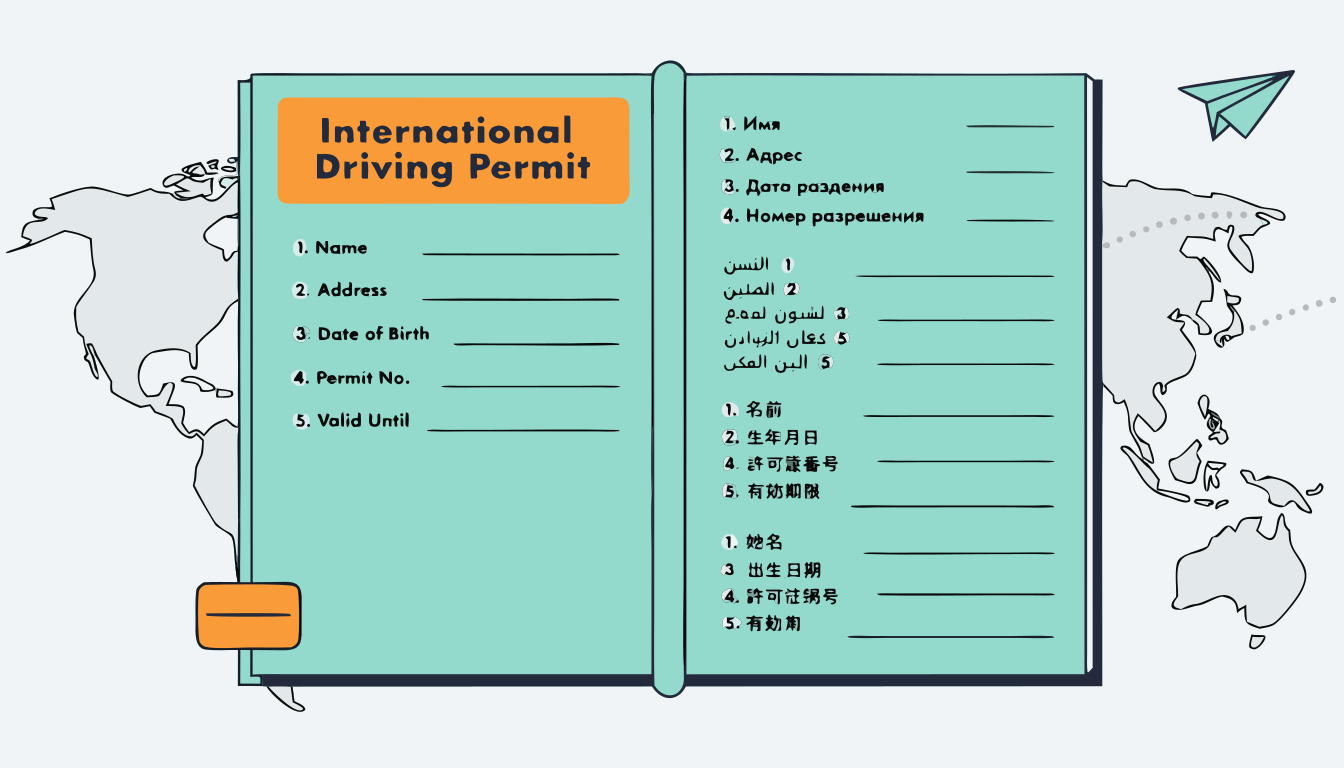
An International Driving Permit is a multilingual translation of your home country driving licence — issued under one of two UN international conventions — that you carry alongside your physical home licence when driving in countries that signed those conventions. It is not, despite the name, a separate licence that authorises you to drive abroad on its own.
The most common misconception is that an IDP is a separate licence that authorises you to drive abroad. It isn't. Your home country licence is the underlying permission. The IDP translates what's on it — your name, photo, validity dates, and the categories of vehicle you're authorised to drive — into a standardised multi-language format that foreign police officers, rental-desk staff, and accident-scene officials can verify in their native script.
Two international conventions govern the IDP system. The 1949 Geneva Convention on Road Traffic (signed September 1949, entered into force March 1952) was the first. Around 100 countries are contracting parties, including the US, Japan, Thailand, Australia, Egypt, and Indonesia. The 1968 Vienna Convention on Road Traffic modernised the format with additional licence categories and security features; around 85 countries have signed or acceded, including most of continental Europe, Russia, and several Middle Eastern countries. A handful of countries signed both. The US never ratified the 1968 update, which is why a US-issued IDP is always Geneva 1949 format — and why a 1968-only IDP issued in, say, Russia is not legally valid in Japan or Thailand.
The practical distinction matters in a small but important set of destinations. Japan accepts only Geneva 1949 IDPs — a tourist arriving with a 1968 IDP from a country that only signed the newer convention has no legal route to drive there at all. Toyota Rent a Car publishes the list of IDP issuers it does and does not recognise on its official site; the constraint is real, not bureaucratic theatre. For most other countries, either convention works in practice.
A government-issued IDP under either convention costs $20-50 in your home country, takes 5-15 business days to receive by mail, and is valid for 12 months from issue. In the US the only authorised issuers are AAA and AATA. In the UK, PayPoint outlets took over from the Post Office in March 2024. In Russia, РОСАВТОКЛУБ. In Germany, ADAC. None of them issue to non-residents — you must apply from your country of residence before you travel.

Which Countries Require an IDP — Browse by Destination
The destination-specific guides below cover legal requirements, rental-desk policy, fine structure, insurance implications, and the most-documented friction patterns. Each guide is updated against Q1 2026 reports from r/IWantOut, FlyerTalk, TripAdvisor and Forum.Vinskogo (for Russian audiences).
Europe — IDP typically required for non-EU drivers
Middle East — Markhoos rules in UAE, Egypt strict on convention
Asia — strict enforcement zones
Latin America — IDP rarely required by law, often by rental policy
Africa — variable, often photocard-friendly
Oceania — typically photocard recognition
Destinations not yet covered with their own guide follow the same archetype patterns — IDP-required strict-enforcement (most of South-East Asia, parts of Africa, Egypt), IDP-required but loose-enforcement (most of Western Europe for non-EU licences), IDP-not-required but rental-desk-conditional (parts of Latin America, Caribbean, photocard-recognition destinations for UK/EU drivers). The country-pair guides above are the canonical reference for each pattern.
The Real Cost of Skipping It
The fine itself is rarely the expensive part. The cost lives in the rental insurance clause that voids the moment a missing-IDP infraction is on record — which transfers liability for any subsequent accident from the insurer to you personally. Three failure modes, escalating left to right.
Rental refusal at the desk
The arrival-day failure mode. You've booked, paid the deposit, queued at the rental row, and the agent asks for the IDP — and refuses to process without it. Local IDP issuance does not exist for tourists in any country we've researched. Your options collapse to: cancel and try a different agency (rare success), take a taxi to the hotel and figure it out tomorrow, or take public transport for the trip. Documented cost: typically the full rental fee forfeit plus the cost of alternative transport plus, in peak season, a multi-day delay before any other agency has cars.
The on-the-road fine
€100-€500 in most of Europe, $50-$120 in Latin America, comparable in South-East Asia. Portugal collects it on the spot via portable card reader; Italy posts it to the rental company which charges your card plus an admin fee. Greece fines the rental company €1,000 separately under the 2018 Traffic Code, which is why no Greek agent absorbs the risk for you. The fine itself is the smaller problem.
The insurance-void cascade
The expensive failure mode. Rental insurance and most travel insurance condition coverage on operating the vehicle in compliance with local law. Without an IDP where one is required, you're by definition out of compliance — coverage stops. Any subsequent accident — including one not your fault — lands personally. Hospital bills in Thailand for scooter crashes routinely start at $10,000. Medical evacuation back to the US/UK costs $50,000-$250,000. This is the cost the IDP actually buys protection against.
How to Prepare Before You Fly
Four steps, ordered by what kills the trip if missed. Check your destination's actual IDP requirement first. Decide between a government IDP and IDP Companion based on speed and where you'll be driving. Verify the licence categories on your home licence cover what you plan to drive — this is where motorbike trips go sideways. Carry both documents physically with you at every interaction.
Check whether your destination actually requires an IDP
Roughly half of common tourist destinations legally require one for foreign drivers; the other half don't but rental companies often do. The country-by-country table below is the fastest filter. If your destination is on the "rarely required" list (Mexico, Costa Rica, Portugal for UK drivers, most of Western Europe for EU/UK photocard holders), you have flexibility. If it's on a strict-enforcement list (Italy, Japan, Greek islands, Indonesia, Egypt), you don't.
Decide between government-issued IDP and IDP Companion
Government-issued IDP from your country's authorised body (AAA / AATA in the US by mail in 10-15 business days, PayPoint outlets in the UK same-day at £5.50 over the counter, РОСАВТОКЛУБ in Russia, ADAC in Germany) is the document you need if your destination is Japan — Japanese rental chains explicitly reject any IDP that is not a government-issued Geneva 1949 IDP, and we are upfront about this throughout. For every other destination in our 22-country-pair coverage, IDP Companion handles the operational friction layer: 2 minutes online from anywhere, $35-55 for 1-5 years, multilingual translation of your home licence, valid alongside the original at rental desks, hotel check-ins, and informal verifications. The trade-off is honest — speed and global access versus the strictest enforcement contexts where only the government document works.
Verify the categories on your home licence cover what you plan to drive
A car-only home licence does not authorise riding a scooter or motorbike abroad — the categories on your IDP mirror your home licence exactly. If you plan to rent a scooter in Thailand, Bali, or Vietnam, you need the motorcycle category on your home licence BEFORE applying for any IDP. Add the category at your home country's DMV/DVLA equivalent first.
Pair with the original physical home licence and carry both
No IDP — government or companion — is valid by itself. Your physical home licence is the underlying permission to drive; the IDP is the translation. Both must be physically present at every rental desk, every checkpoint, every car-hire pickup. Digital copies are widely refused, especially in the UAE, Japan, and Thailand. Print the IDP Companion before flying and carry it in the same folder as your passport.
Special Cases the Standard IDP Question Misses
Motorcycles, long-stay residency triggers, and cross-border rentals each have their own layer of rules that the standard IDP question doesn't touch. Below: where each one diverges from the base case and what closes the gap.
Motorbikes and scooters
An IDP translates only what your home licence already permits. A car-only home licence (US Class C, UK Category B, Russian Категория B) does not authorise a motorbike or scooter — including small-displacement scooters in Thailand, Indonesia, Vietnam, and most of South-East Asia where the local rule starts at any displacement over 50cc. Get the motorcycle category added at your home country DMV/DVLA equivalent before any IDP application. Travel insurance also typically excludes two-wheelers unless you've explicitly added the motorbike rider — most standard policies don't include it by default.

Long-stay and digital-nomad scenarios
Tourist driving privileges have hard expiration dates. Most countries set them at 90 days from entry; Italy and Japan at 12 months; Portugal at 185 days. Once you cross that boundary, residency licensing rules take over — you're expected to obtain a local licence under any reciprocity agreement that exists or take the local driving test. An IDP doesn't extend this window. For digital nomads on long-stay visas or visa-free hopping, this becomes the operational constraint above the IDP question.
Cross-border rentals
Most rental contracts explicitly prohibit cross-border travel without written permission and additional insurance. A Croatian rental into Slovenia, a Greek rental into Albania, a Czech rental into Hungary, a US rental into Mexico — each crosses an insurance boundary that voids the default contract. Declare any multi-country itinerary at pickup and pay the cross-border fee, or plan to return the car and rent again in the next country. The financial exposure on a cross-border accident in an unauthorised rental can match the insurance-void cascade described above.
Cyrillic, Greek, Arabic and Asian-script licences
Drivers whose home licence is in a non-Latin script (Russian, Greek, Arabic, Chinese, Japanese, Thai) face a doubled friction layer in many destinations — the legal IDP requirement plus the physical-readability gap when a rental agent or police officer cannot transliterate the home licence at all. The IDP solves both problems simultaneously by presenting the licence in a multi-language Latin-script format. Russian drivers travelling to Turkey, UAE, Egypt, Thailand, Indonesia, and Greece encounter this consistently; the country-pair guides above document the specific patterns per destination.
Frequently asked questions
The questions we hear most often from travellers researching IDPs — direct answers first, supporting context second.
Depends on where you're going and what you're driving. Roughly 100 countries are signatories to the 1949 Geneva Convention on Road Traffic, which legally requires foreign drivers to carry an IDP alongside their home licence. Another 85 are on the 1968 Vienna Convention. Some countries (Mexico, Costa Rica, parts of the Caribbean) accept your home licence alone for tourist stays. The rental desk question is often more decisive than the legal question — many international rental chains list IDP as a booking condition regardless of national law. The country-specific guides linked below break this down per destination.
They're two separate international conventions with different signatory countries and slightly different document formats. The 1949 Geneva Convention IDP is recognised in countries like the US, Japan, Thailand, Egypt, and Indonesia. The 1968 Vienna Convention IDP modernised the format and is recognised across most of Europe, plus Russia and several Middle Eastern countries. The US never ratified the 1968 update, which is why a US-issued IDP follows the Geneva 1949 format. A 1949-issued IDP is not valid in countries that only signed 1968 (and vice versa). Most countries accept either, but the specific format matters in a handful of strict-enforcement destinations — most notably Japan, which rejects anything that isn't a Geneva 1949 IDP issued by an authorised national body.
For a government-recognised Geneva 1949 IDP, you have one option per country: AAA or AATA in the US, PayPoint outlets in the UK (replacing the Post Office in March 2024), РОСАВТОКЛУБ in Russia, ADAC in Germany. These take 5-15 business days by mail (US/UK) and cost $20-50. The catch: you must apply from your country of residence — they don't issue to foreign tourists who are already abroad. IDP Companion is a private multilingual translation document that pairs with your home licence at most rental desks and informal verifications — it's generated in 2 minutes online from anywhere in the world for $35, valid 1-5 years. It is not a government-issued IDP and we're upfront about that throughout this site.
Inconsistently — and that's the trap. Major chains at airport rental rows in heavily-visited destinations (Rome FCO, Athens ATH, Madrid MAD, Bangkok BKK) check at least some of the time. Smaller agencies on tourist islands and in regional cities check less consistently. Q1 2026 r/IWantOut and FlyerTalk threads show the strictest enforcement clusters at: Italian airport rentals, Greek island agencies on Santorini/Naxos/Folegandros, Japanese rental chains nationwide (Toyota Rent a Car explicitly publishes which IDPs they accept), and Indonesian Bali rentals. The risk asymmetry matters more than the average rate: a rental refusal on arrival day is a vacation-day-zero crisis with no recourse.
Modest on its own — usually €100-€400 in Europe, $50-$120 in Latin America, similar in South-East Asia. The financial damage doesn't live in the fine itself. It lives in the rental insurance clause that voids coverage the moment a missing-IDP infraction is on record. That means any subsequent accident — even one not your fault — lands directly on you personally. Hospital bills for foreign tourists in Thailand routinely exceed $10,000. Medical evacuation costs $50,000-$250,000. The IDP doesn't prevent crashes; it prevents the insurance-void cascade that follows.
Most standard travel and rental policies condition coverage on "operating the vehicle in compliance with local law." If the destination legally requires an IDP and you don't have one, you're by definition not in compliance — coverage stops at that point. World Nomads, Allianz, Generali, and most major US/UK travel policies use this clause. Credit card rental insurance (Visa, Amex, Mastercard) is even more restrictive — many policies explicitly exclude countries from coverage, and most cap at 31 days. Read your specific policy before assuming you're covered. If the policy is silent on IDP requirements, the local-law-compliance clause still applies by default.
No — and we don't claim it is. IDP Companion is a private multilingual translation document presenting your home licence in 12 languages from the 1949 Geneva Convention character set. It pairs with your physical home licence to reduce friction at rental desks, hotel check-ins, ferry counters, and informal police interactions where a translated reference of your licence resolves the verification faster than the foreign-language original alone. It is not a government-issued IDP under either international convention. For destinations with strict government enforcement (Japan being the most documented case), you need the authorised national IDP. For most other destinations, IDP Companion handles the operational friction layer.
Government-issued IDPs (AAA, AATA, PayPoint, РОСАВТОКЛУБ, etc.) under both Geneva 1949 and Vienna 1968 are valid for 1 year from issue. Most countries also require the IDP to have been issued within 12 months of arrival — Japan specifically validates against your entry stamp date, so a 13-month-old IDP doesn't work even if technically still within validity. IDP Companion is valid 1, 3, or 5 years from purchase, tied to your home licence — if your home licence expires before the companion period ends, the companion expires with it.
Yes — and this is where most uninformed travellers run into trouble. An IDP translates exactly what your home licence permits and nothing more. If your home licence is car-only (no motorcycle category), your IDP also doesn't cover motorbikes — including scooters. In Thailand and Indonesia, a car-only home licence means you cannot legally rent a scooter even with an IDP, and your travel insurance voids if you ride one. Get the motorcycle endorsement (Category A in EU/UK/Russia format, Class M or equivalent in the US) added to your home licence BEFORE applying for any IDP. Otherwise the IDP is paperwork that doesn't solve the actual problem.
Yes initially, but it shifts. Most countries' tourist-driving privileges expire at the 90-day, 180-day, or 12-month mark depending on the destination. Once you cross that boundary, residency licensing rules take over — you're expected to obtain a local driving licence or convert your home licence under any reciprocity agreement that exists. Long stays in Portugal (185 days), Italy (12 months), Japan (12 months), and Costa Rica (90 days) trigger residency licensing requirements. The IDP itself doesn't solve this — it covers the tourist window, after which the local licensing process kicks in. The country-pair guides below cover residency triggers per destination where they apply.
Only with the rental company's written permission, which is rarely included by default. Most rental agreements explicitly prohibit cross-border travel without an upgrade and additional insurance. Crossing into a country with different driving rules (e.g. a Croatian rental into Slovenia, a Greek rental into Albania, a Czech rental into Hungary) frequently voids both insurance and contract. If your itinerary covers multiple countries, you typically need to either: (a) declare the route at pickup and pay the cross-border fee, (b) return the car and rent again in the new country, or (c) take public transport / rideshare for the cross-border leg. Verify in writing before booking — this is one of the most expensive surprises in international car rentals.
Your home country's government-IDP issuer (AAA, PayPoint, РОСАВТОКЛУБ, etc.) won't issue to you while you're outside the country. Your practical options: (a) IDP Companion — generate online in 2 minutes from your hotel for $35, prints from any printer, covers the multilingual-translation friction layer; (b) ask the rental company in advance whether they'll process the rental on your home licence alone (some chains will, especially during off-peak; many won't); (c) skip the rental and use Grab/Bolt/Uber/private driver for the trip. Most destinations have at least option (a) as a fast bridge.
Related guides and references
Cross-references for the questions this guide doesn't fully answer.
Generate your IDP Companion before you fly
Multilingual PDF translating your home driver licence into 12 widely-spoken languages from the 1949 Geneva Convention set. Generated from your real licence in 2 minutes online. Print at home, at the hotel front desk, or from any internet cafe abroad if the original is lost. Valid 1, 3, or 5 years — covers this trip and the next ones across every destination in our country-pair coverage.
Get IDP Companion — $35Sources and references
- United Nations Treaty Collection — 1949 Geneva Convention on Road Traffic, current contracting parties list
- United Nations Treaty Collection — 1968 Vienna Convention on Road Traffic, current contracting parties list
- US Department of State, Bureau of Consular Affairs — international driving information for US citizens
- UK Government (gov.uk) — driving abroad, post-Brexit licensing recognition agreement (2020)
- European Commission — driving licence recognition framework for non-EU residents
- American Automobile Association (AAA) — IDP issuance policy and country requirements
- American Automobile Touring Alliance (AATA) — IDP requirements and FAQs
- PayPoint UK — IDP issuance information (replaced Post Office in March 2024)
- Toyota Rent a Car — official IDP acceptance policy (Japan)
- Country-specific traffic codes: Codice della Strada (Italy), Law 4850/2021 (Greece), Decree-Law 138/2012 (Portugal), Ley 9078 Article 91 (Costa Rica), Article 88 of Law 2918 (Turkey), Law No. 22/2009 (Indonesia), Federal Law of the Russian Federation on Road Safety
- Reuters and Reuters Health — international travel insurance industry analyses on coverage clauses tied to local-law compliance
- World Nomads, Allianz, Generali — published policy terms for travel insurance with motorbike rider and IDP-compliance clauses
Legal disclaimer
IDP Companion is a private multilingual translation companion document and is not affiliated with the United Nations, any national government, or any authorised IDP-issuing body. IDP Companion is not a government-issued International Driving Permit under the 1949 Geneva Convention on Road Traffic or the 1968 Vienna Convention on Road Traffic. Authorised national issuers of Geneva 1949 IDPs include AAA and AATA (United States), PayPoint outlets (United Kingdom, replacing the Post Office in March 2024), РОСАВТОКЛУБ (Russia), and ADAC (Germany). IDP Companion must be used alongside your original physical driver's licence and is intended to reduce verification friction at rental desks, hotel check-ins, and informal verifications — not to replace a government-issued IDP where local law specifically requires one.